

When we published what to build for Solana DeFi in March 2024, the ecosystem was still recovering from FTX’s collapse. The teams that stayed kept shipping, even when the market had stopped paying attention.
Two years later, Solana holds more than $16 billion in stablecoins and processes $360 billion in monthly stablecoin transfers. Tokenized RWAs grew from near zero in early 2024 to $4.2B with ~600k holders, up 71% in the past month.
One benefit of bringing equities onchain is that the market doesn’t close. This year, 63% of tokenized-equity spot volume on Solana happened outside U.S. exchange hours.
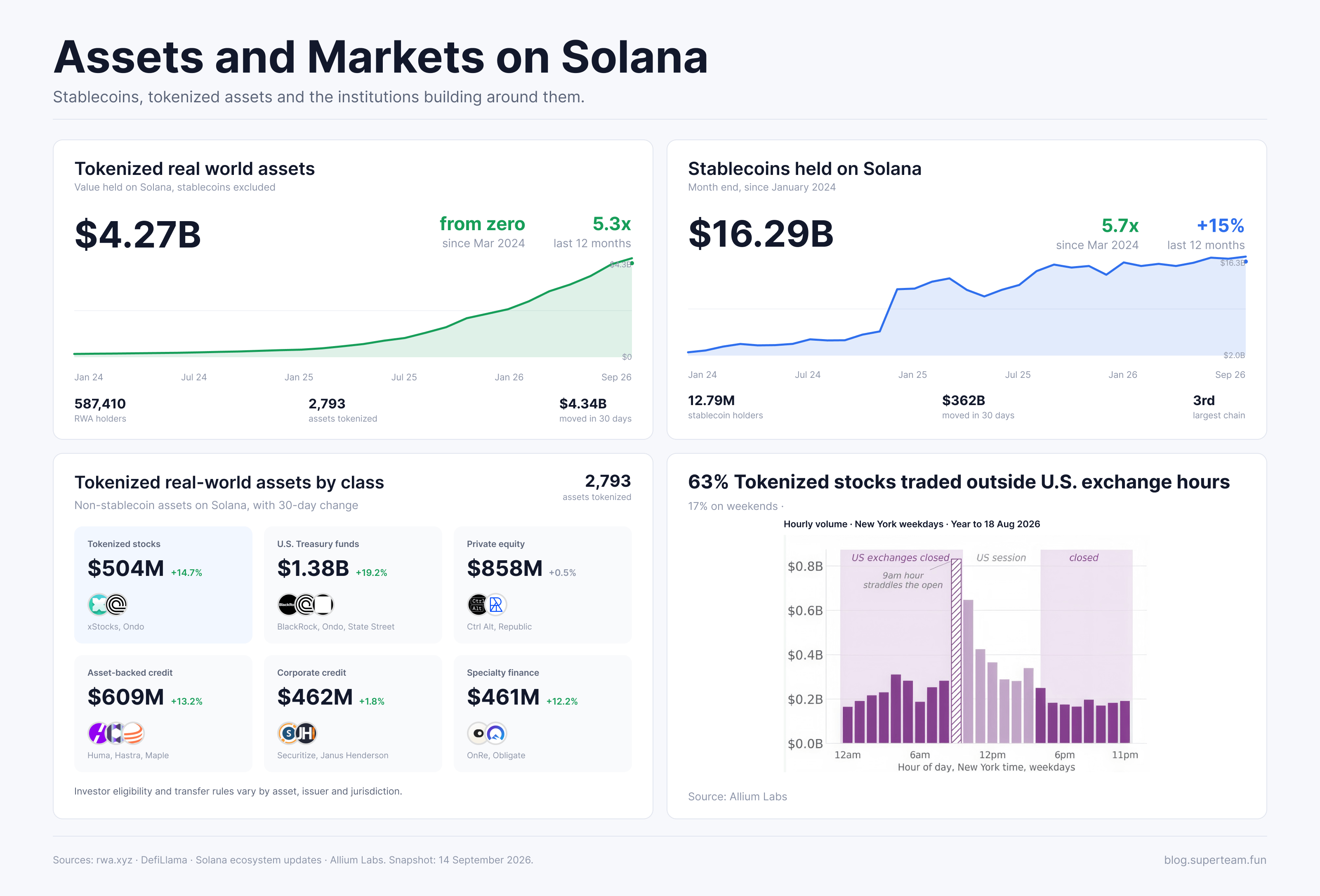
Raydium has processed more than $4 billion in tokenized-stock trades by August. And DeFi platforms like Kamino, Jupiter, and Loopscale support tokenized stocks as collateral, so holders can borrow against their holdings without selling them.
Teams are also testing new use cases for these assets. StonkFun lets you launch coins paired with tokenized stocks and has made over $1.2 billion in cumulative trading volume as of September.
Programmability opens up many such use cases: anyone can now buy and hold global assets, borrow against them, or automate how they invest.
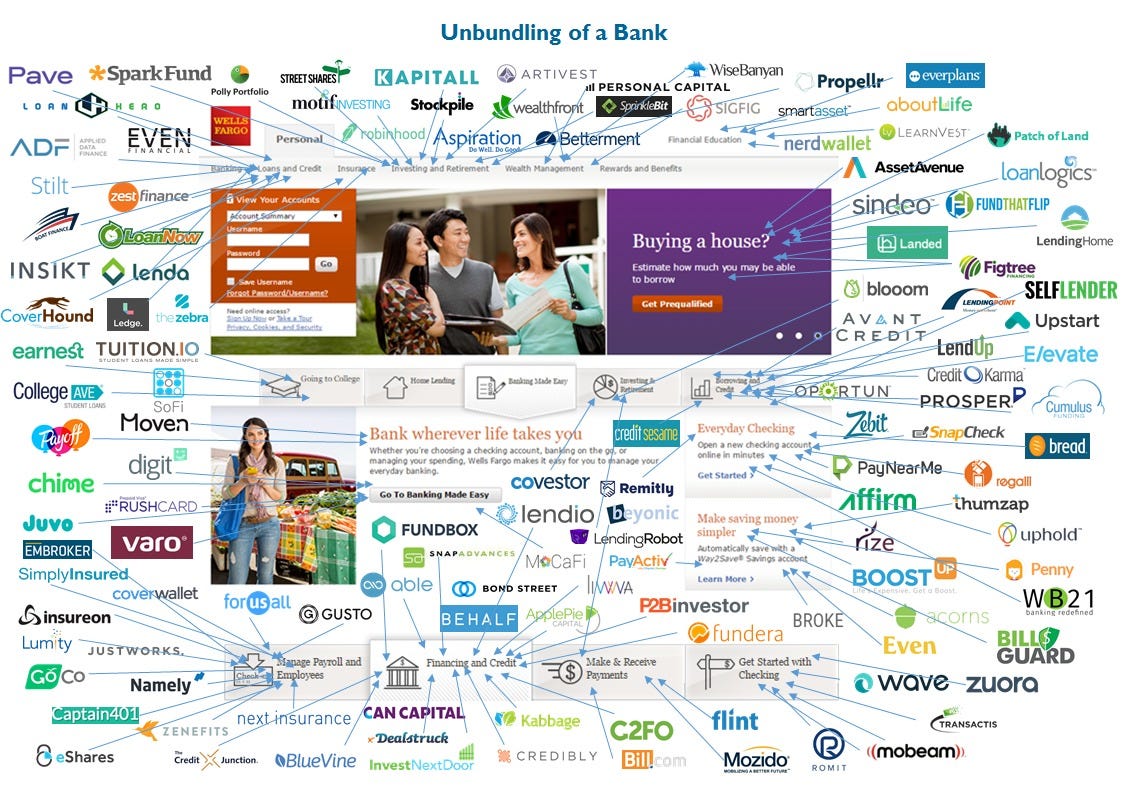
A founder can build around one of these services or combine them for that customer. Jim Barksdale put it nicely:
“There’s only two ways I know of to make money: bundling, and unbundling.”
A bank is a bundle of businesses. It holds your savings and receives your salary. A bank can sell you a credit card, insurance, a mortgage, and a brokerage account. Each service gives the bank another way to earn from an existing customer. A startup can re-skin one service the institution handles poorly, or combine a few for customers that the bank overlooks.
So what deserves to be a product of its own?
We asked founders and builders across Solana what they would want to be built in DeFi today, including ideas worth revisiting now.
Big thanks to Ramzy (Solana Foundation), Kash (Jupiter), Matty (Colosseum), Yash (SendAI), Saurabh (Decentralised.co), Lucas (Jito) and Cavey (Temporal) for sharing the ideas that shaped this article, and to Yash, Paarug and Naman for their feedback on early drafts of this essay.
If you are deciding what to spend the next few years building, we hope you find a question here worth staying with.
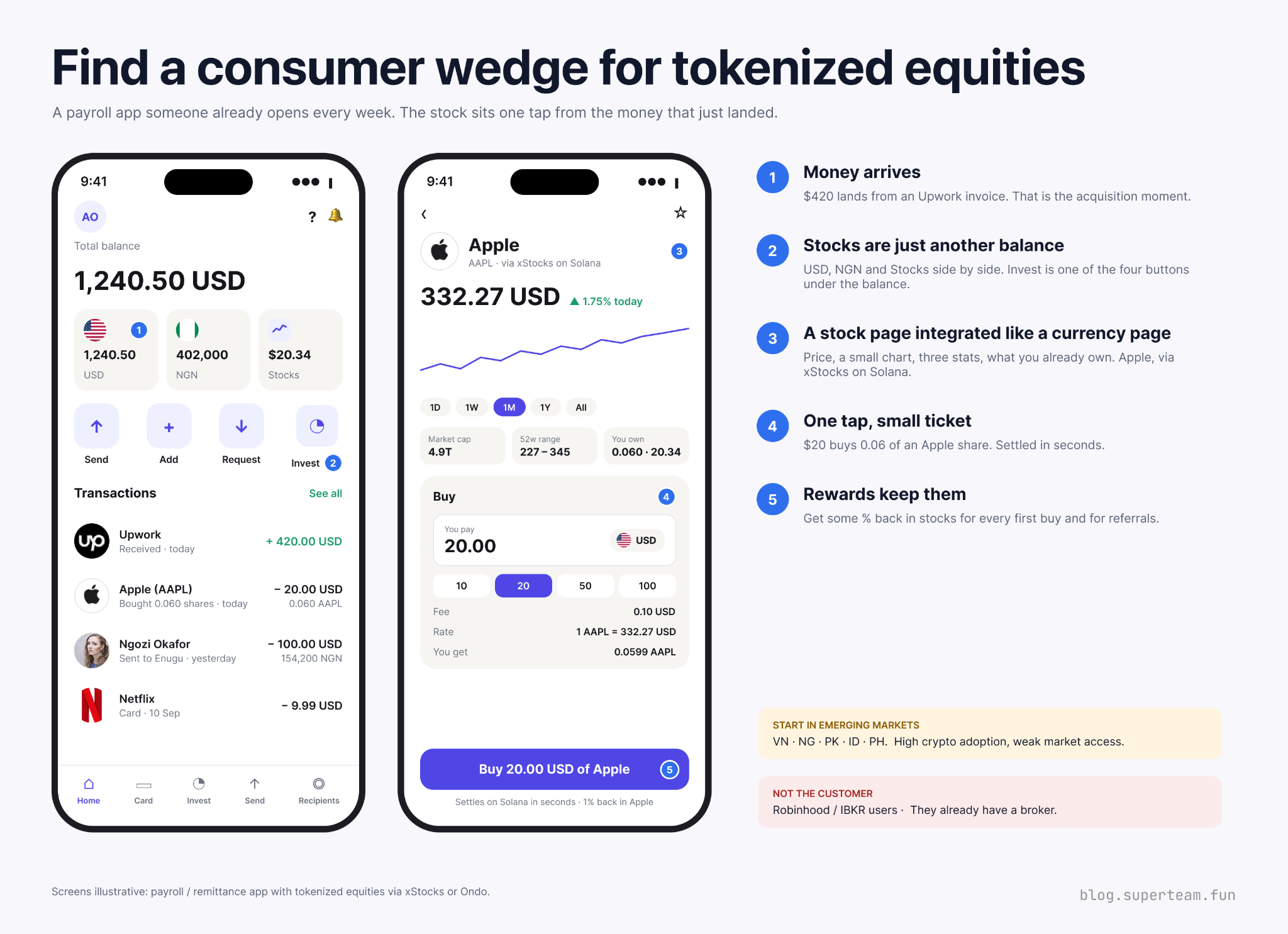
1. Find a consumer wedge for tokenized equities
“Find a new way to get a consumer audience to try trading tokenized equities. Mobile-first and geo-specific GTM” — Ramzy (Solana Foundation)
The tokenized equity supply on Solana is at an all-time high of $684 million. Supply is no longer a problem.
xStocks alone has brought more than 700 stocks and ETFs to Solana.
As of writing this, about 800K addresses hold tokenized equities on Solana. Robinhood has about 28.4 million funded customers, and Groww, a single Indian app, has 12.9 million active investors. Many of their users had never owned a stock until an app made it super easy to do so. The stocks are now onchain; we still need to bring the next million users.
A new app needs a reason for existing users to switch from their brokerage app and give a starting point for someone who has never owned a stock.
People in emerging countries like Vietnam, Nigeria, Pakistan, Indonesia, Ukraine, and the Philippines have a thin choice of local stocks, and investing in global markets is slow, expensive, or blocked.
The gap exists on the other side too.
Recently, Uzbekistan’s national fund got listed in London to reach more global investors. A bit north of there, you will find Kazakhstan. Not a name you see in the shiny headlines, but the Kazakhstan government bonds have matched the S&P 500 returns in USD terms over five years. Tokenization opens up opportunities like this to the world.

Where do you find them? Start bottom-up where the flow of money is.
There are many freelancers who receive money from outside; they could invest part of the payment before cashing out. Someone could be following an IPO but never got a chance to invest in it.
The lesson for an app is to start with a task the customer already needs to complete. Payroll apps, remittance products, and investing communities sit close to these actionable moments.
For example: Travellers in other countries often had issues paying local vendors. LocalPay helped them pay in Southeast Asia with stablecoins.

2. Markets for the risks we actually live with
“One of the biggest financial positions many of you will ever hold is the one you can’t actually properly hedge. It’s your house.” — Matty (Colosseum)
An insurance policy covers a fire or a break-in but doesn’t account for your city getting 20% cheaper. On the other side, people saving to buy a house carry the opposite risk, as prices keep rising while they save.

U.S. House Price Index Report - 2026 Q1
In 1993, Yale economist Robert Shiller wrote Macro Markets, proposing markets for the risks that dominate our lives, like home values and wages. One chapter also described perpetual futures contracts, and we all know crypto’s already brought that concept to market in a big way. But there’s the rest of the book, which is waiting to be implemented.
Shiller actually tried with housing futures, which launched on the CME in 2006, and it primarily didn’t work out because of liquidity.
Building a perp on a metro housing index could become useful at this point in the economy. Renters could go long so the market can’t run away from them, and homeowners could go short to protect their house. If all of that works, maybe many people around the world could potentially hedge their real estate holdings.
In theory, this would offset part of the risk most people carry.
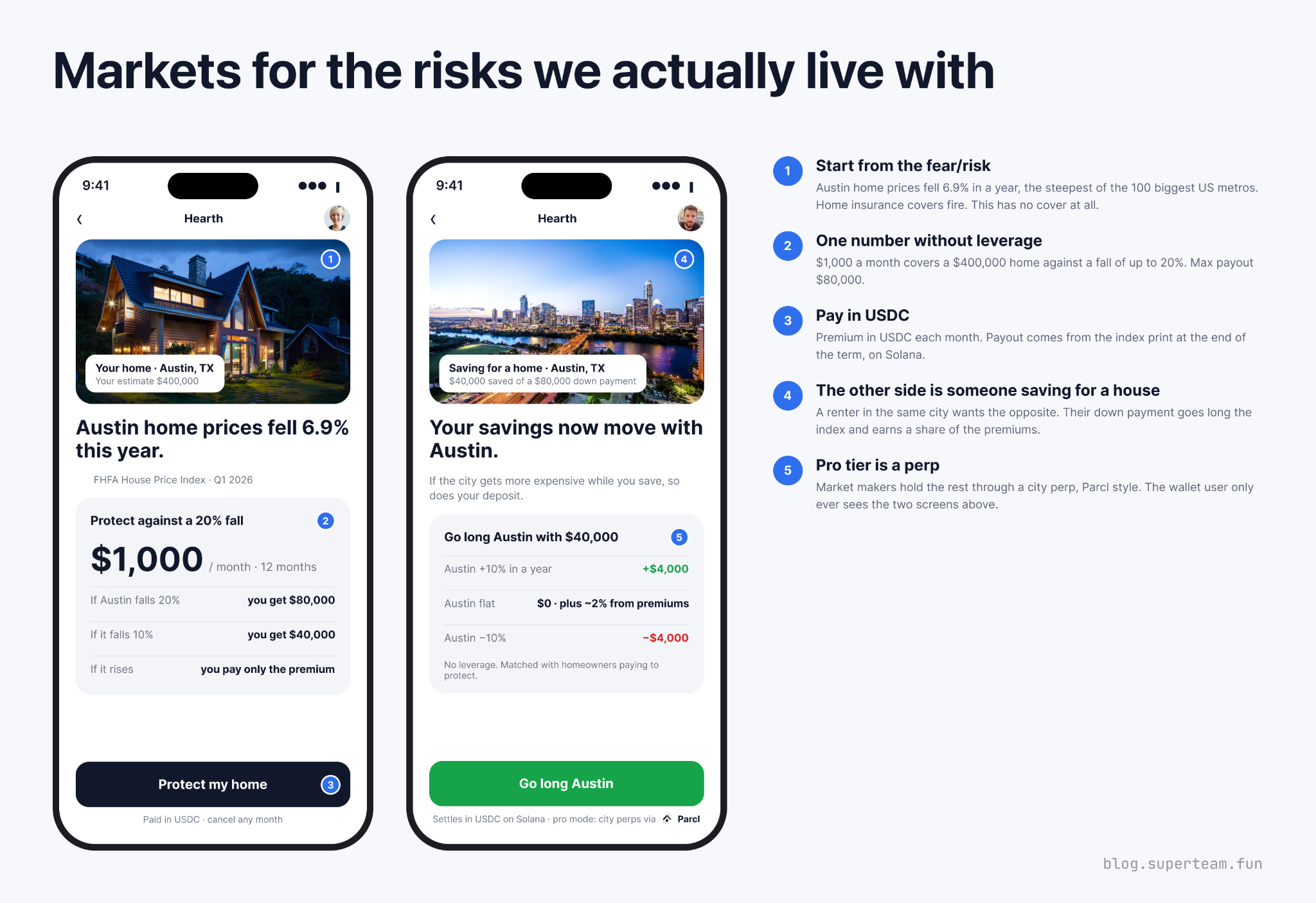
Most homeowners will not want the hassle or the technicalities of managing leverage or funding rates.
A simpler product could charge a fixed premium to protect the house and pay out if the local housing index falls by 20%. Someone saving for a house could buy the opposite long exposure.
The mismatch between the index and the actual house will be the difficult part to solve.
How do you make sure what a house on a street is worth? How do you index that and update it over time? What factors to use? How do you solve the liquidity problems?
If you know how to price a house better than Zillow does, this one’s for you.
3. Yield from risks outside crypto trading
“anything around uncorrelated yields is super interesting right now. that’s the holy grail of onchain lending” — Kash (Jupiter)
Solana has many yield products, but fewer independent sources of yield.
While Lending yields, LP fees, basis trades, and leverage might look like different products, many depend upon crypto markets being active as a source of yield.
There is no free lunch in finance. So if trading activity/volume goes down, yields could also go down directionally.
That’s starting to change.
For example, Huma’s PST funds short-term payments like global settlement, card payments, and trade finance. OnRe’s ONyc earns from reinsurance premiums and returns on its collateral.
Both do carry some risk. PST carries the payment-financing risk; and when insurance claims run higher than expected, ONyc yields could drop too. But neither risk depends on crypto activity/volume. The same logic could apply to consumer credit, commodities, or businesses that need short-term capital for reasons unrelated to crypto prices.
Right now, for parking funds, crypto users mostly pick between stablecoins, a basket like JLP, or going all in on SOL, BTC, etc. There’s not much in between.
Traditional markets have always had a mix of different assets for different risk profiles and time horizons. We will soon see the rise of such options on-chain too.
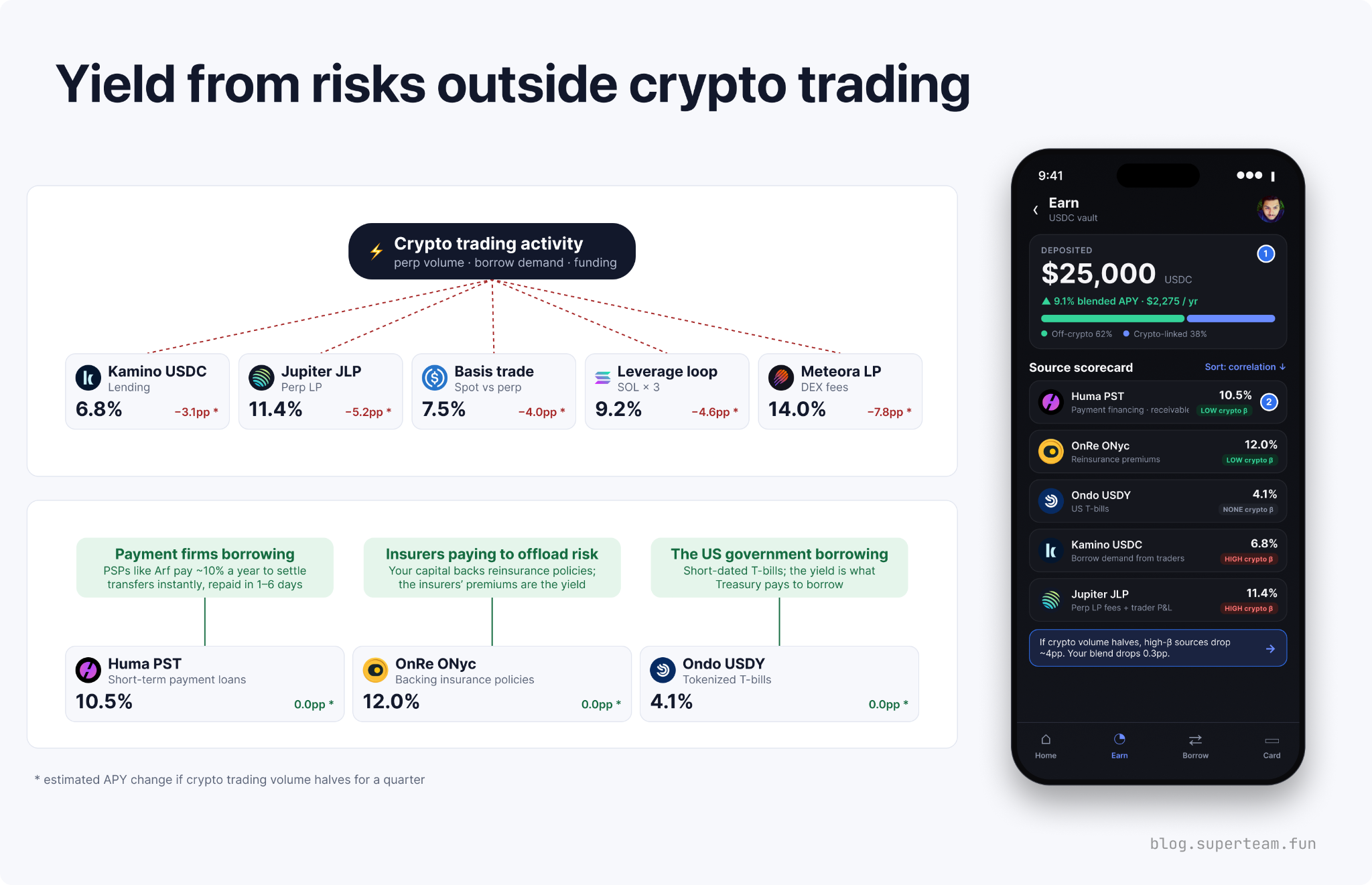
On the infra side, there’s opportunity for teams that could underwrite these assets properly, bundle unrelated cash flows, or make them usable in existing lending markets. Uncorrelated yield is the holy grail for a reason. It’s hard to fake and hard to find.
4. Build credit, not just lending
Idea from Saurabh, Decentralised.co.
In DeFi, when you take a loan/borrow, you have to put up more collateral than you borrow.
Undercollateralised lending as a category has been surfacing in every discussion for a long time. Most of the problems with its implementation have come down to three things: Who is borrowing? Can they repay? What stops them from walking away?
Some of the tools are getting there.
With Solana Attestation Service, issuers can attach KYC, professional/employment credentials, etc to wallets. Tala, a digital lender in emerging markets, partnered with Huma to bring consumer loans onchain with a $50M USDC facility.
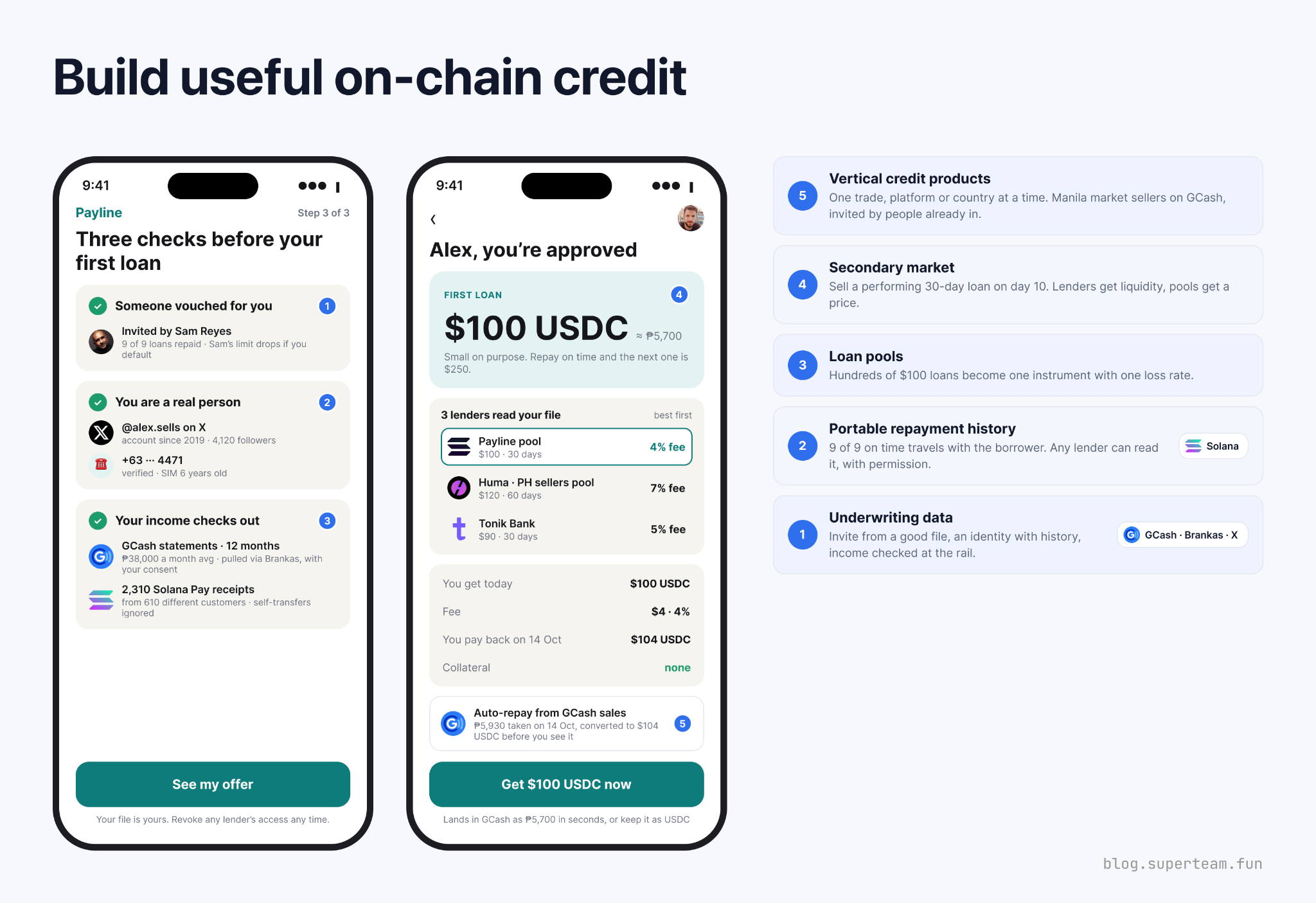
A team could start with one layer of the lending process:
Underwriting APIs:
Pull attestations, payment history, and off-chain data into one score lenders can plug into.Portable repayment history:
This could help borrowers to port their repayment history from one to another and get another loan.
Pooled loans:
This can spread risks across small, different risk-adjusted loans into one instrument for lenders.
Secondary markets where lenders can sell performing loans before they mature
Go vertical:
Instead of putting everything on-chain, pick one profession, platform, or country where income can be checked and repayments collected.
5. Make Solana’s yield curve liquid and useful
Idea from Saurabh (Decentralised.co)
Most DeFi loans have floating rates that move with demand and pool utilization.
A fund may borrow USDC for a trade that settles in six months for them. Here the fund knows when the position ends, but cannot predict its financing cost.
If they want to lock in that financing cost, a fixed-rate loan can give them the predictability.
If similar loans trade across one, three, or several-month maturities, their rates begin to form a yield curve. This can later be used to price loans, fixed-yield products, and interest-rate derivatives.
Parts of this already exist on Solana. You can trade PT (Principal token - fixed yield part) and YT (Yield Token - variable yield part) with Exponent and RateX. And Loopscale uses a different design. It does offer fixed-rate, fixed-term loans, and they are matched directly between lenders and borrowers through an orderbook.
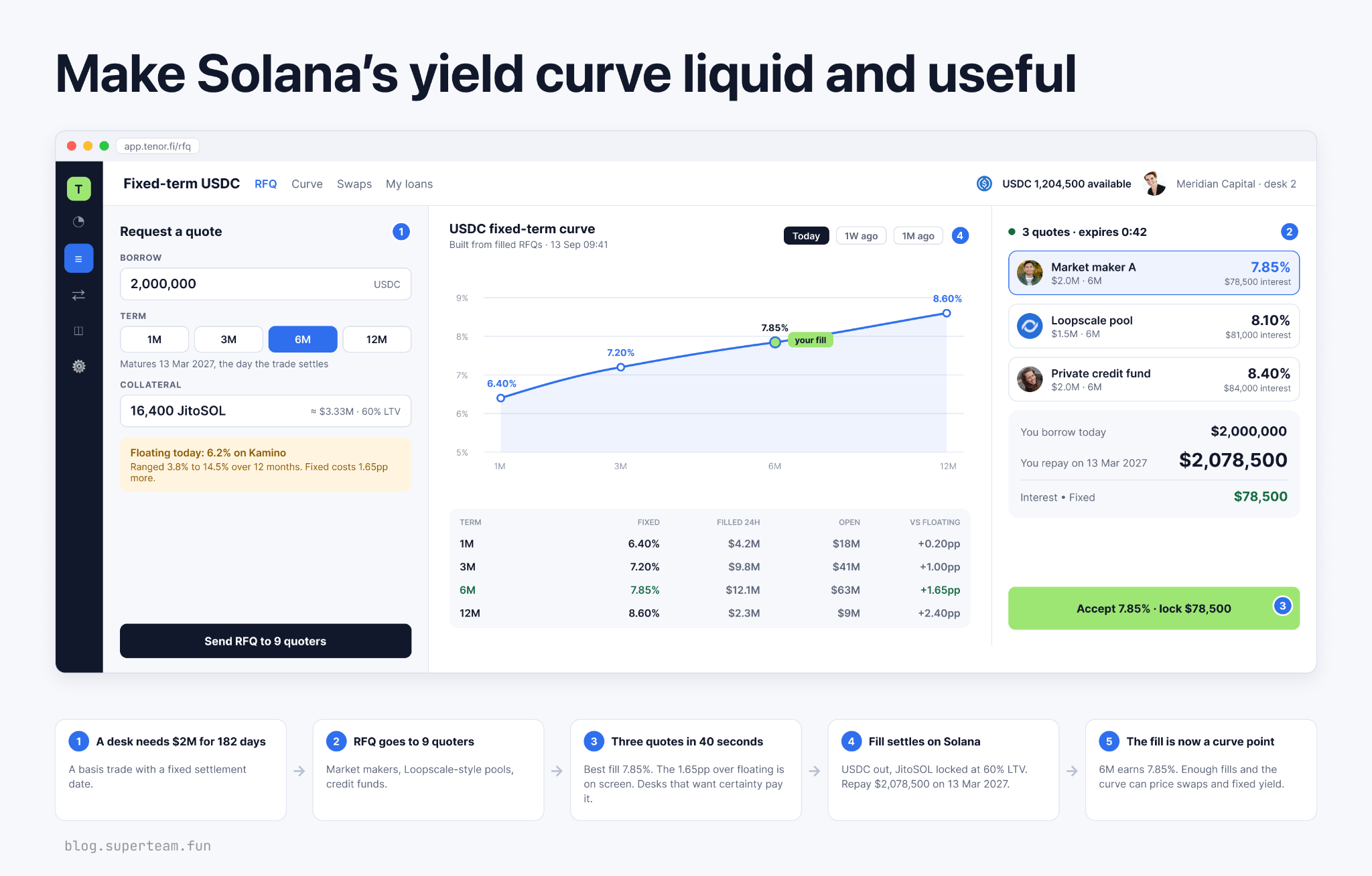
Existing DeFi users could swap their existing loan to lock in a fixed USDC rate instead of paying a floating rate.
But liquidity gets divided across every asset, maturity, and collateral type. So start narrow, with USDC and a few standard maturities. An RFQ system could let borrowers seek offers for a specific amount and duration.
Some who could benefit are funds financing trades with fixed settlement dates; market makers funding businesses with recurring working-capital needs may have a genuine reason to pay for certainty.
And it’s been tried before. Yield Protocol shut down in 2023, partly struggling to find sustainable demand for fixed-rate borrowing. Most users picked fixed rates only when they were cheaper than floating ones. A team therefore needs to find borrowers who repeatedly want predictable financing.
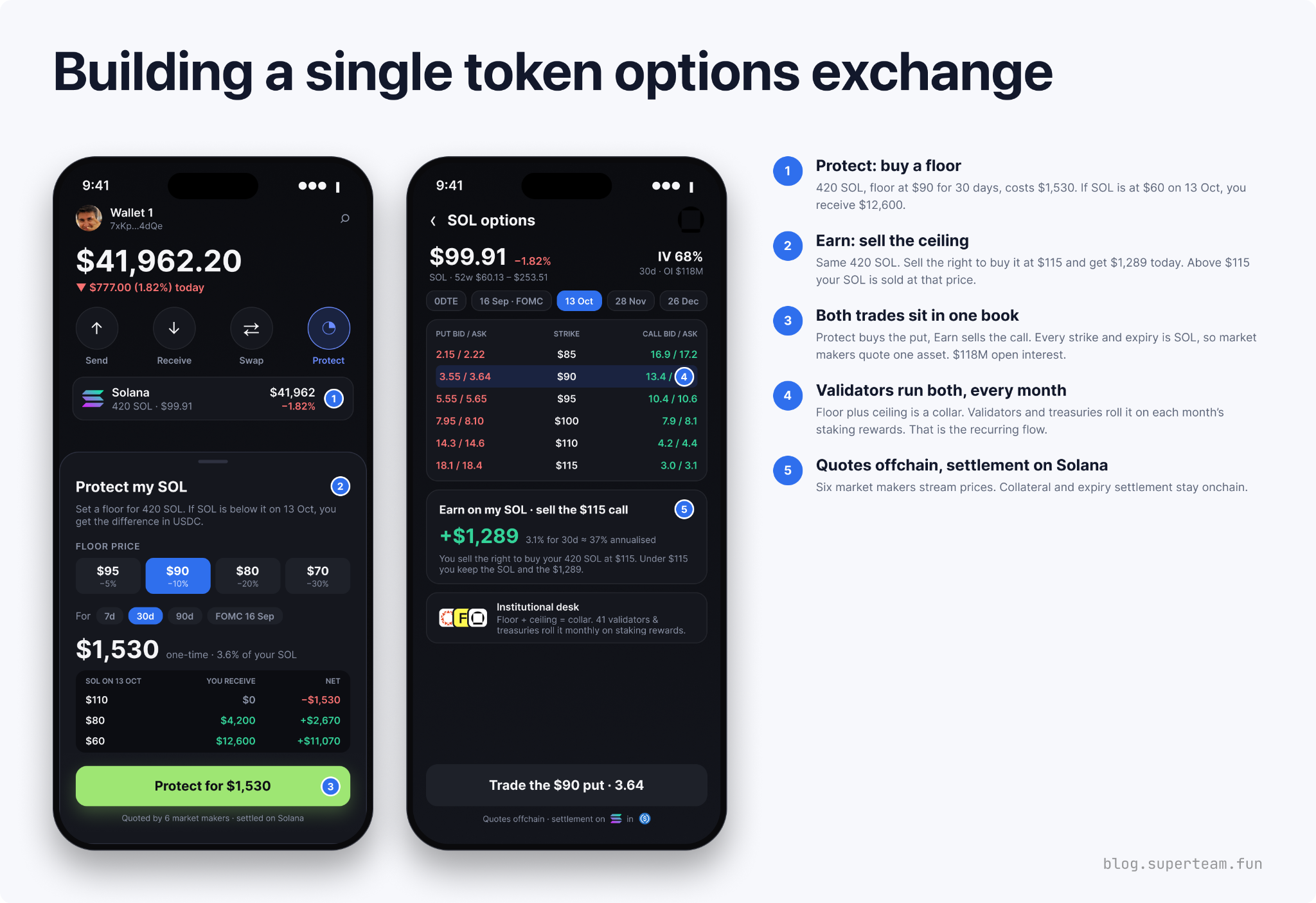
6. Win the SOL options market
Solana has seen plenty of attempts at options exchanges.
But most struggled with liquidity fragmentation. Each new token creates dozens of new markets and splits traders and market makers.
Try a different approach and focus entirely on SOL. PsyOptions previously shut its order-book product because there was not enough on-chain volume. Instead of supporting every token with an oracle price, prioritize trader concentration, collateral, and market makers around one asset.
Only settlement needs to happen on-chain. Market making can happen off-chain, with collateral and final settlement on Solana.
Places to start:
Short-dated SOL options, including SOL 0DTE options, or around events like FOMC meetings, CPI releases, or big Solana events.
Structured products like covered calls, cash-secured puts, and downside protection.
Simple wallet integrations like “earn yield on SOL” or “protect my SOL.”
Hedges for Validators, funds, and SOL treasury companies
CME, the Chicago-based derivatives exchange, launched SOL options in October 2025. Its SOL futures and options traded $37.7 billion, with $2.25 billion of open interest at its peak in 2025.
SOL is large enough to support its own options market. The opportunity is to build one suited to crypto users around one asset, with continuous trading and settlement on Solana.
7. Build an open clearing layer for DeFi
Idea from Saurabh, Decentralised.co.
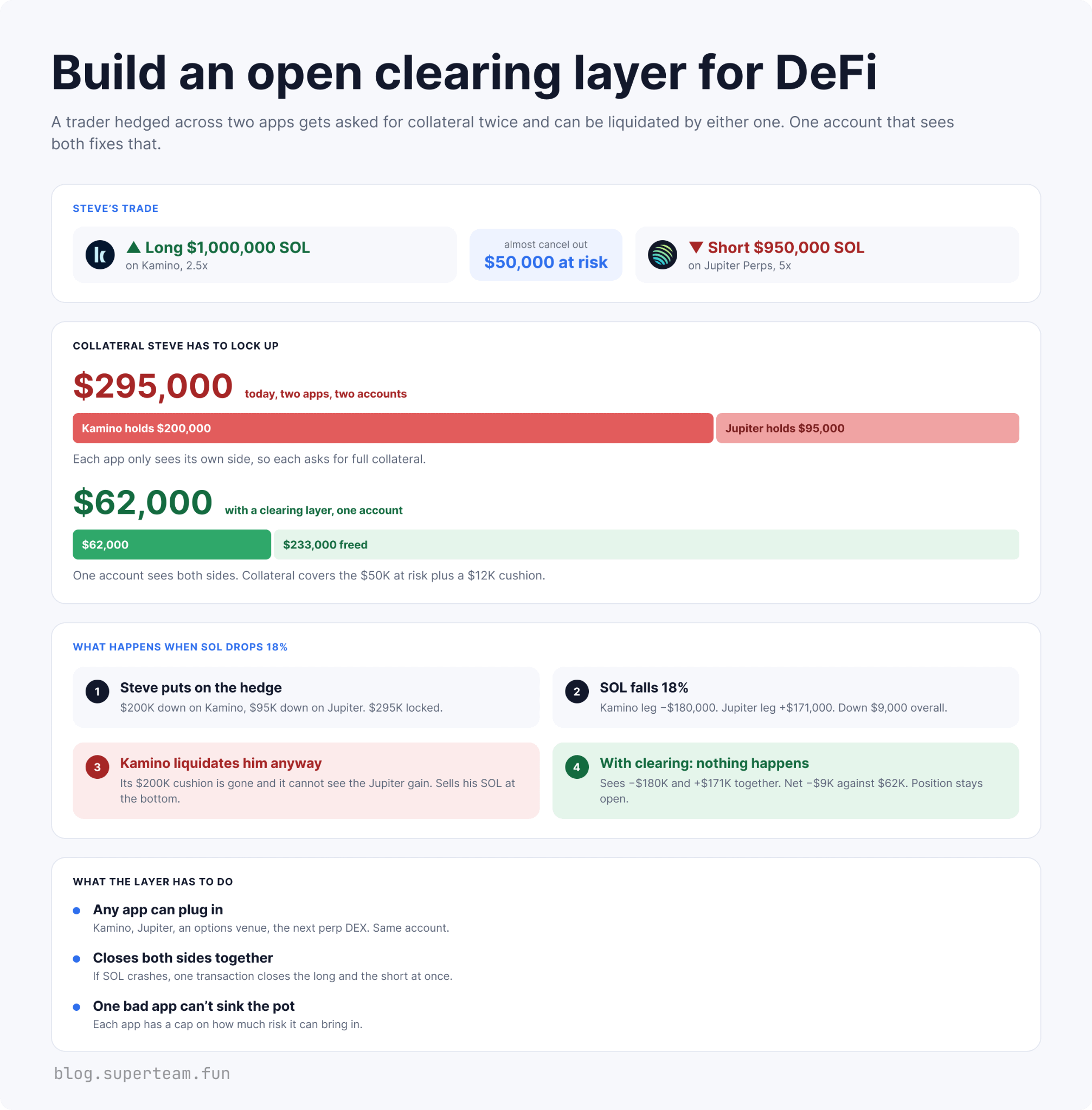
If a trader is 2.5x long $1 million of SOL on Kamino and 5x short $950,000 on Jupiter Perps. Net real exposure is $50,000. But neither venue accounts for the other position, so each can demand full collateral and can liquidate SOL on their own.
For example, if SOL dropped 25%, one side can get liquidated, and the other side makes money.
In traditional markets, this is handled by a “clearing house”. Once the exchange matches a trade, the clearing house tracks the position until it’s closed, nets everything against what the trader is holding, and handles the defaults.
In DeFi, an open clearing layer would track these positions under one margin account, net exposures, and coordinate liquidations across venues.
Project 0 is the closest thing on Solana. It lets users post collateral from venues like Kamino, Jupiter, Drift (previously) to contribute towards one unified margin account.
The next step from here is an open clearing layer that nets positions across venues, be it a perps exchange, a lending market, or an options protocol that it could plug into.
Some starting points:
Standard position adapters: every venue reports collateral, exposure, oracle prices, and liquidation rules the same way.
Conditional portfolio margin that offsets hedged positions when both sides can be unwound safely.
Cross-venue liquidations: let liquidators unwind several connected positions in one transaction instead of racing across separate accounts.
Default isolation: cap how much risk each venue can import. An oracle issue or illiquid memecoin market should not pose risk to shared collateral.
8. Token launches need better market design
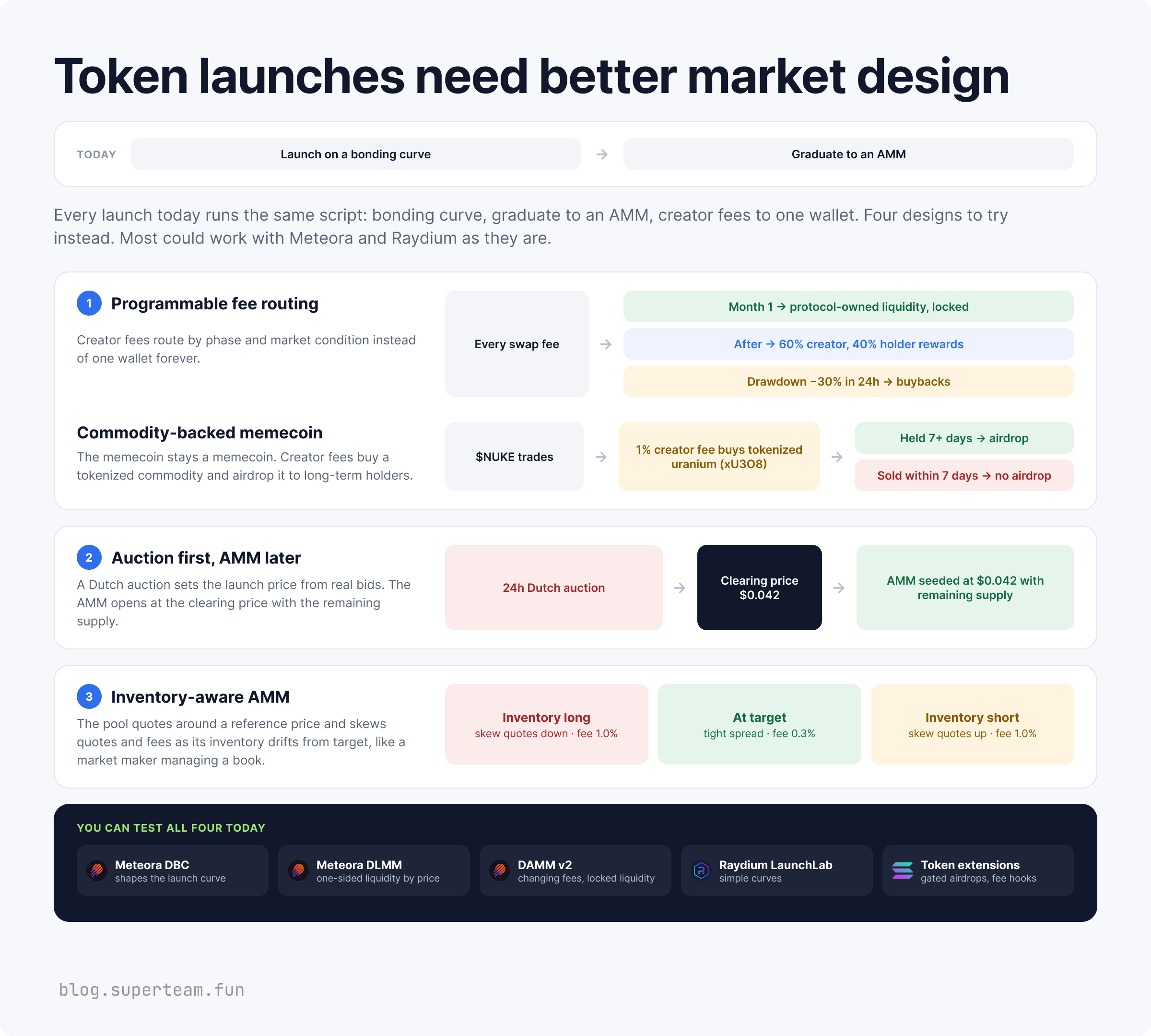
Almost every memecoin on Solana now launches the same way. It trades on a bonding curve, then graduates to an AMM.
Pump made it the default and later moved graduations into PumpSwap. Raydium LaunchLab added fixed-price and linear curves. Meteora DBC lets you stack curve segments and set their own schedules and migrate automatically into a DAMM pool.
In Ethereum, apps can use Uniswap V4 to customize swap and liquidity behavior. Doppler runs an auction for price discovery before settling into an AMM. Flaunch sends trading fees to creators, treasuries, or token buybacks.
Ideas worth testing on Solana:
Programmable fee treasuries:
Early fees could go into building liquidity owned by the project before gradually moving towards creators or token holders. Another version could spend fees on buybacks during sharp selloffs.
E.g. Commodity memecoins with fee-funded rewards:
Imagine a $NUKE coin using creator fees to buy tokenized uranium, then airdropping it only to wallets that held for more than seven days. The memecoin stays separate from the commodity, and trading activity funds the reward.Auction first, AMM later:
Use a Dutch or batch auction for initial price discovery, then use the AMM with the clearing price with whatever tokens are left.Inventory-aware AMMs:
Quote around a reference price, then widen prices and fees as inventory moves away from its target. This is closer to how a market maker manages a book than sitting on one fixed curve indefinitely.
Most of this does need a new AMM.
Meteora DLMM supports one-sided liquidity across price bins. Its DBC can shape the launch curve; DAMM v2 supports changing fees and liquidity locks. Can use Raydium for simpler designs. Build a new AMM only if the logic has to run inside every swap, like idea 3. Otherwise, the existing infrastructure is probably enough to find out whether any idea works.
Token-led marketplaces
Yash argues that DePIN will come back in this cycle.
Last time in 23-24, DePIN projects paid suppliers long before finding enough buyers. Tokens were launched at high valuations with low float (supply), and teams regularly sold rewards to cover expenses in fiat. Even when the network attracted usage, that activity often had little connection to the token.
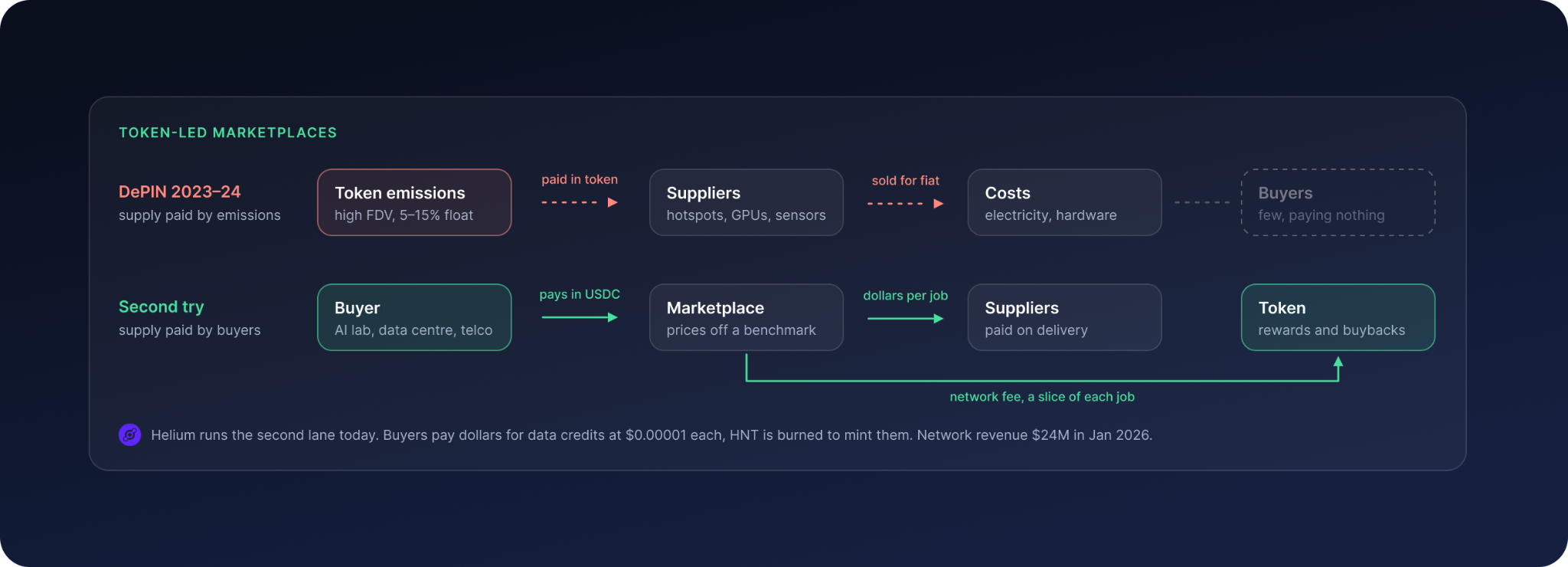
A new marketplace could separate payment for the service from the incentive used to build the network. Buyers pay for compute or energy in stablecoins, and network fees fund supplier rewards or buybacks.
Projects can also launch with less supply and use external benchmarks to price resources such as compute or electricity.
9. Solana needs more trading apps
“Building another perp DEX is waste of effort, more trading apps should be encouraged” — Yash
Crypto users like to speculate. Solana users probably more than most.
Speculation isn’t a bug, and It’s time to stop pretending this is an embarrassing side effect and treat it as its own category.
Axiom, pump fun and GMGN weren’t a new trading primitive; they built better interfaces around the existing trading behaviour people wanted to express.
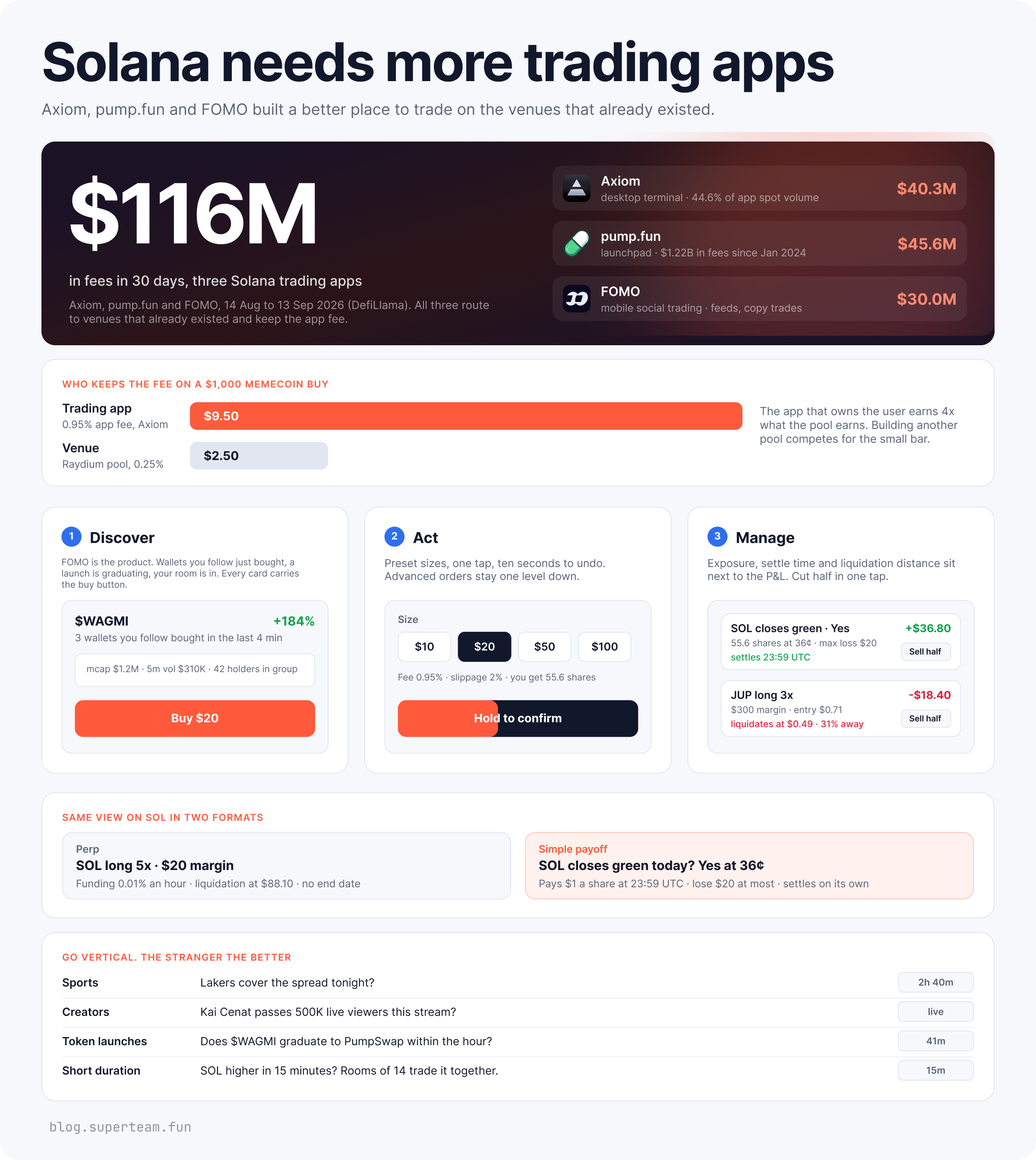
Any trading product has three jobs: help users discover assets, let them act, and make positions easy to manage. Miss one and the product falls apart.
Invent new discovery and trading loops:
Discovery should feel endless. Feeds, charts, wallets, and alerts should lead directly to an action. Explore more personalized feeds. Traders want an edge or the feeling that they have one.Make action instant:
If buying or selling takes a thought, it’s extra cognitive load. Having preset order sizes and buy or sell buttons next to every alert can shorten the gap between conviction and action. Show immediate feedback, but keep advanced orders available with optional controls.
Make speculation multiplayer:
Private rooms, team competitions, shared watchlists, and short tournaments can help convert socially discussed alpha into a trade. Positions, PnL, exposure, and liquidation risk should stay visible and easy to adjust.
Existing spot, perp, and prediction-market infrastructure can sit underneath. Focus on feeds, livestreams, group chats, mobile, AI, and simpler payoffs.
Pick a niche: sports, creators, internet culture, token launches, markets that settle in minutes. All of it still depends on fast execution and fresh data.
10. Build markets before they become obvious.
Most exchanges start by copying the products everyone already knows how to trade.
Sometimes it could be a lagging indicator of alpha. And it’s a crowded game. A better question is what people are already trying to trade before an actual market has been built for it.
“Build markets that don’t exist anywhere else” — Lucas (Jito)
Pre-launch markets are a good example. Long before they became a product, traders were already trying to figure out what a token should be worth before TGE. The market existed loosely in group chats; eventually it became a venue.
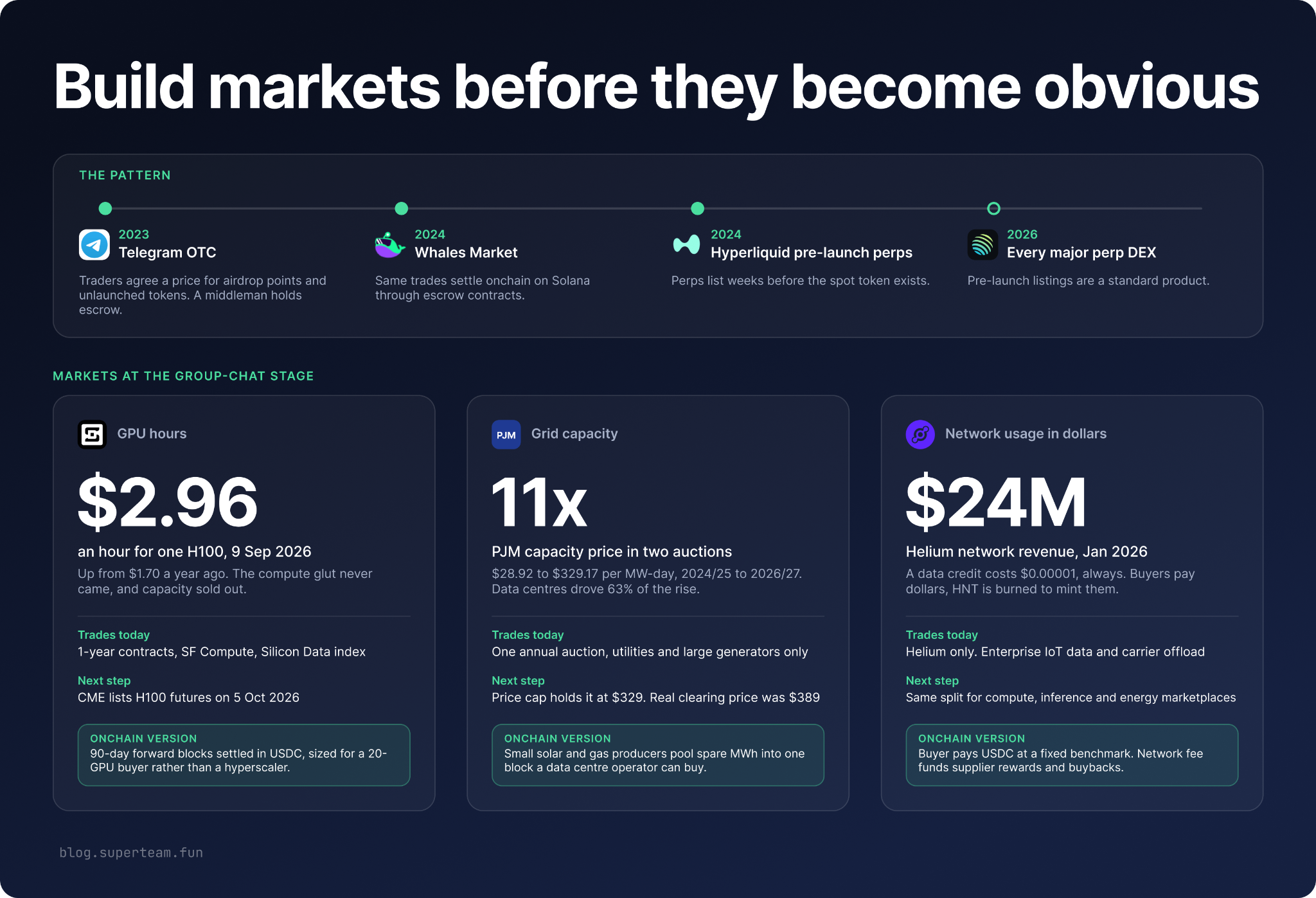
New kinds of scarcity
A16z raised its $1.1B Machine Age fund on the bet that AI is hitting physical limits, be it compute, memory, networking, data centres, or power. That scares things in the AI age; eventually will be a market.
A data centre could sell future blocks of compute capacity before new machines are installed
Smaller power producers could pool spare capacity and sell it to buyers who wouldn’t deal with them one on one.
The product could be a forward contract, booking system, or financing market rather than a traditional crypto exchange.
Different market mechanisms
Prediction markets design still feels pretty open, to be honest. Not more markets around news, but different ways to use the existing markets and adding more programmability.
“We need more prediction markets.” — Cavey (Temporal)
Some directions to experiment with:
Yield from near-certain outcome:
A “No” share trading at 96 cents on a market that will never resolve to an “Yes” is a 4% return, paid only when the market settles.
Two researchers from Munich, Gebele and Matthes (May 2026), measured this settlement discount across Polymarket and found it sums up to 88% of the price gap on near-certain contracts.
One product could buy 97-cent shares and earn the buffer, or a lending market that lets holders borrow USDC against them.Machine forecasters as the liquidity:
On Metaculus, the best bot finished 33rd of 1,130 humans this spring. Within a year, bots might be the median forecaster.
Build the market where agents are the default participants and humans back them: stake USDC behind a bot’s track record, share its P&L, withdraw it when it can’t perform.Fade the worst:
Everyone is trying to follow the winner. What if you pick the absolute loser, who has the best track record at being wrong in predictions, and take the opposite side?A leaderboard sorted the opposite way. Most confidently wrong wallets of the week, by peer score, last 90 days.
A vault that buys No whenever the bottom pile buys into Yes, in the same block, at the same price.
Fade filters: single-market gamblers, post-resolution buyers, new wallets with one lucky hit. Polymarket’s own copy-trading guides list these as red flags.
Fun side tracks can be like “fade-my-friend:
Pick one wallet in a group chat and auto-take the other side of everything they do. Settle up at the end of the week.
What will you build?
In 2010, Chris Dixon wrote, “the next big thing will start out looking like a toy.”
The internet, the first phone cameras, early social networks. Now AI.
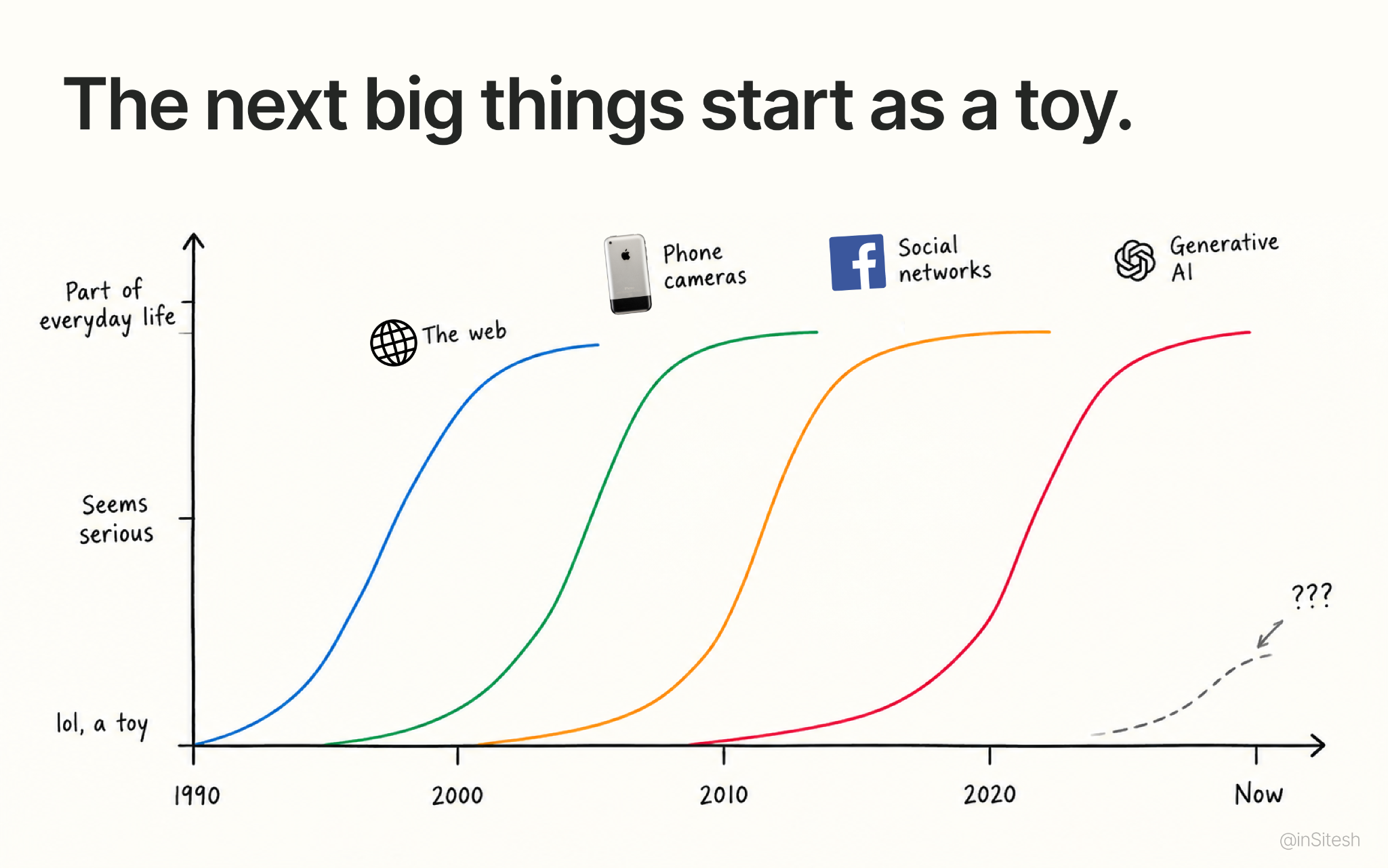
A lot of the things we now take seriously were dismissed when they came out. Take AI, for example: in 2023, the viral video of Will Smith eating spaghetti looked so broken that it became a meme. Many skeptics dismissed it, saying a machine can never be ‘creative’.
Three years later, the same video is almost used as a benchmark for how quickly these models have improved.
Some of the ideas in this essay might look like toys. It’s tempting to rank them below the serious ideas like credit, clearing layers, uncorrelated yields, etc.
The serious ideas and toys need each other for the ecosystem to thrive. More traders attract more market makers. Better markets bring more traders. It’s how the flywheel runs.
Most people won’t arrive here just through an infra pitch. Decentralization alone might not be enough. They’ll arrive because something was fun, useful, or strange, and they stayed.
You need to start somewhere - most of these ideas are the floor, not the ceiling.
Whichever you pick, start smaller than it feels comfortable and ship that. Pick one asset, one city, one group chat, and build for them until they’d be upset if you stopped.
Come join the Arena
You don’t need a year to test one of these. Colosseum’s Crypto World’s Fair hackathon is live until October 12, with an $800k prize pool and $2.5 million from Colosseum’s venture fund.
If you’re up for taking a shot at any of these ideas, or building a serious startup this hackathon season, DM @paarugsethi on Telegram; we would love to help you out.
And if you want to hear from us and some of the best minds in the Solana ecosystem, along with hundreds of builders, join us at Solana Summit India in Mumbai on November 2. It’s curated for ambitious builders like you.
Feel free to reach out if you have any suggestions. If you found this even a little useful, please share it. It makes the weeks of work worth it and helps it reach more builders.
Disclaimer: This essay reflects my personal views and does not represent any organisation or constitute financial advice. Ideas attributed to contributors have been expanded with additional research, and figures are accurate as of writing but may change. Projects mentioned are for illustration purposes only, not endorsements; nothing here is financial, legal, or life advice. So please do your own research.